31/03/2015

Andrew Chauni Ho


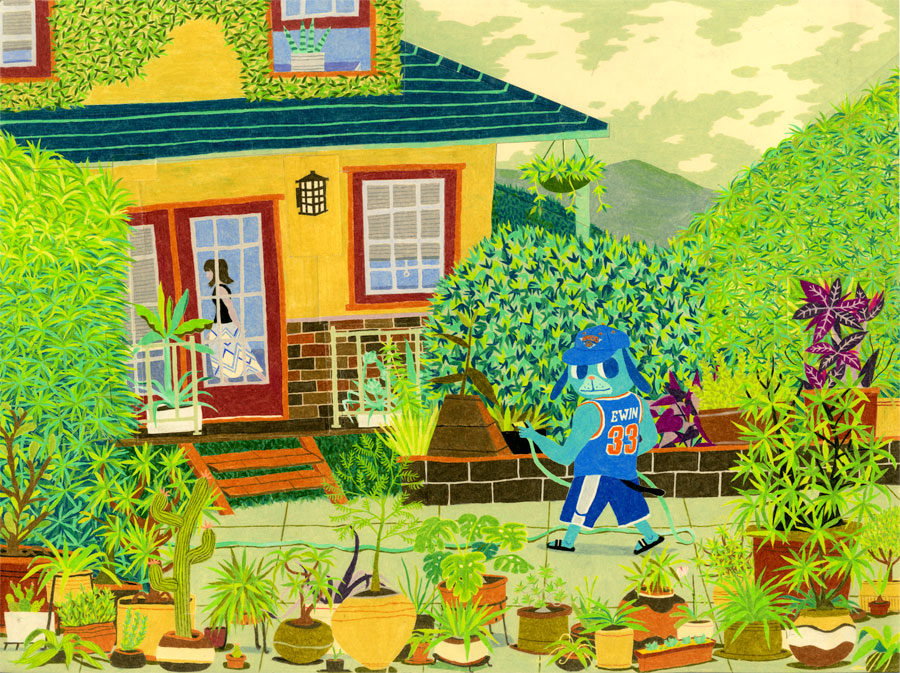
Looking at Chuani Ho's work it feels that he has created a world for himself in his creations. The characters, the scenes all seem to work in conjunction with one another. What struck me most about his work is that he works in coloured pencil- which for me was completely unexpected as I had assumed he worked in gouache or another paint media. But looking closer, you can just see the subtle pencil touches, and I wonder why he chooses to work in pencil rather than paint. Maybe he finds he is able to refine his images more. Regardless, there's a huge level of craft in his image making and it has inspired me to experiment more with my media and try and use it in different ways like he has.

DUST: Drew Millward exhibition at Colours May Vary

I admire Millward's work but definitely have a preference for some of the simpler prints that I saw that night. I sometimes find the (impressive) amount of detail overwhelming to look at and whilst it can be fun to look through lots of details these sometimes just hurt my eyes! I like how Millward is able to hone more simpler pieces that are still recognisable as his work.


25/03/2015

improvements + aspirations session task (?)

I sometimes struggle with making these lists. One of my points for things I want to get better at should really have been "making points for PPP lists". It's reminded me to be more introspective of myself.

In regards to places I'd like to go, none really have anything to do with illustration but are more of, as a whole, aspirations in my life, which I suppose would be influenced by my career! In regards to people I'd like to meet- well- I find it strange to aspire to want to meet people. I suppose it is nice to converse with artistic heroes, but it's something I struggle with at conventions for sure.

THINGS I WANT TO KNOW MORE ABOUT:

  • how to get paid as an illustrator
  • how I can use social media to my advantage as an illustrator
  • how do I get work as an illustrator
  • how self initiated work can become part of my practice
  • how can I make my work - really good - 
  • fun facts for interesting conversation!
  • some more cooking skills
  • stuff about science
  • maybe a language
PLACES I WANT TO GO / PEOPLE I'D LIKE TO MEET:
  • someone who will give me a good job
  • the mountains of norway
  • tokyo
  • new york (it's a popular choice)
  • that one island filled with deer in Japan
  • canada - where, who knows
THINGS I WANT TO GET BETTER AT:
  • creating interesting concepts
  • quickly generating ideas
  • using language in image making / copy
  • self-discipline in drawing
  • recognising my strengths and weaknesses
  • creating compositions
  • making illustrations that are enjoyed by others/ suit there audience
  • food making
  • self-confidence!


superpowers + personal ad

superpowers:

*** Clearly though one of my 'Kryptonites' (that I hadn't realised before) is organisation though as since this session I haven't been able to find my physical work for either of these two tasks! Since this incident I am more cautious about keeping work ***

But one of my strengths / superpowers I recall was time management, as I am rarely late to sessions and deadlines. I remember that my sidekick was the character from the Fuzzy Logic posters I drew- I think it probably is a strength that I have been making some paid work already- and I am also a little proud of the little dog I drew.

personal ad:

"WILL DRAW YOU SOME QUALITY CARTOON 
ANIMALS BUT DON'T EXPECT ME TO 
COOK FOR YOU"

These were the first 20 words to come to my head- and strangely enough for one this initial idea was the best one I could come up with (in the time given). Although I don't want to hole myself into the idea that I can only draw cutesy stuff and I'd like to think that I am more ambitious than that I am aware that that is probably something I am somewhat known for and played on this.

personal management / study / practical skills session recap

I suppose it was useful to distinguish between personal management, study and practical skills. Dividing them up you may generally find that there is an area that you struggle with mostly, although you are bound to have areas in each one that need work. Nevertheless it is good to remind yourself where you have come and where you need to go, as otherwise you won't be able to improve!

PERSONAL MANAGEMENT SKILLS:

  • time management (not being late)
  • reflection
  • blogging frequently
  • learn to make mistakes
  • persistence / don't give up
  • confidence to present work
  • eating + staying alive living alone !
  • money / financial management
  • balancing work and social life
  • being open minded

STUDY SKILLS:
  • how other illustrators work
  • knowing where illustration is
  • how to find new illustrators - collecting inspiration
  • how to give and receive (good) feedback
  • process + types of illustration
  • using blogs (for research and reflection)
  • using reference material
  • knowing the difference between images + illustration

PRACTICAL SKILLS:
  • working quickly
  • working with roughs and scamps
  • developing practical skills in software and different media
  • image making
  • craft
  • importance of colour, shape, line etc (visual language)
  • using blogs
  • composition + formats
  • developing characters + narrative
  • developing a tone of voice
  • draw all the time!

21/03/2015

visual language end of module evaluation

1.  Which practical skills and methodologies have you developed within this module and how effectively do you think you are employing them within your own practice?

Although I have mentioned working with shape in other module evaluations, it was in Visual Language these considerations began! I think I am starting to improve with shape- particularly as now I will sometimes not even consider using line as a means of image making. That said, I can’t become too involved with shape, and need to experiment more.

The first half of the module got me to experiment with media more although I think I lost touch with this particularly as I progressed on to the second half, and with other modules.

Thumbnailing has been key in all of the visual modules so far, but I have found it particularly useful in the composition tasks of Visual Language. Now when I create images I mostly create them with a frame in mind straight away- I find it generates ideas quicker and saves time.

2. Which principles/ theories of image making have you found most valuable during this module and how effectively do you think you are employing these within your own practice?

This module has introduced me to the idea of good sketchbook practice- not so much in making the book itself look good but rather disregarding such aesthetic in favour of making lots and not being afraid to make mistakes! This has helped my work in other modules too.

I most enjoyed, and also found most useful the second half of the visual language module- learning about composition and placement specific elements in an image. Whilst I think other elements such as line and texture are important, I consider the other the main building blocks of an image and the foundations of which good illustration is made on. I took care to try and employ these in my final visual language piece- the screen print- and I think it worked quite effectively.

3. What strengths can you identify within your Visual Language submission you capitalise on these?

As before, I think most of my strengths lay in the more composition based tasks. Whilst I think I worked these well into my final screen print I will also continue to consider these in all I make. In a way it relates to the idea of thumbnailing too.

I think my work that was the more stand-alone pieces, such as the print and line of sight image, were stronger than my sketchbook pieces. I felt myself putting more effort and time into them, perhaps because superficially they seemed more important. However, in a way I think this was a good thing as often I am more inclined to make half finished sketchbook work and this forced me out of this comfort zone.

4. What areas for development can you identify within your Visual Language submission and how will you address these in the future?

My lens and non-drawing based image making was poor and badly made. I suppose this needs more practice, and with that one of my sure weaknesses is that I rarely consider working beyond drawing and, sometimes, painting.

Whilst the first half of the module forced me to work in different media towards the end I found myself back in my set ways of tone of voice and media usage. I need to stay aware and consider more experimental things, otherwise I will never improve! I think I became lazy with my sketchbook based work.

5. In what way has this module informed how you deconstruct and analyse artwork (whether your own or that of contemporary practitioners)?

Practicing identifying different elements of other peoples’ work in the visual language taught sessions and deconstructing them in this way helped me be critical of them too. By simplifying the image or illustration in this way I can create an almost mental-checklist of what is there, what could or should be there and how they work together.

There is no reason this logic cannot be applied to my own work either! Whilst having more ‘elements’ does not necessarily make a better picture it is helpful to consider what isn’t there- and whether it could be useful. For example, I was concerned that my image for print was not visually interesting enough, and it was suggested that I look at adding depth that was not there beforehand.

20/03/2015

10 STATEMENTS (RULES)

  1. I will not be a pessimist, but will also not ignore the flaws  
  2.  I aim to participate more in group sessions
  3.  I will analyse and scrutinise my work closer
  4.  I will paint more, I will make something three dimensional!
  5.  I will learn about the practice of illustration but also involve myself in it
  6.  I will read journals and books about other disciplines, I will visit galleries
  7.  I will visit museums and listen to podcasts! I will read more
  8.  I will use my diary, and create timetables
  9.  I aim to draw every day
  10. I will practice and study lettering 

10 STATEMENTS

  1. I will become more confident in what I do and what I make
  2. I will become more confident in speaking out
  3. I will recognise my strengths and weaknesses
  4. I will experiment more with my image making
  5. I will learn about and consume more illustration
  6. But I will learn more about the wider world of art and design and not limit my studies to illustration
  7. + with that, I will learn more about the world in general! general knowledge can't hurt !!
  8. I will organise my time and learn how to best prioritise things
  9. I will discipline myself in drawing and image making
  10. I will become good at typography and lettering

product poster


I received some positive feedback for this poster.

  • "Funny + looks very professional. Good concept for poster also."
  • "Positive, funny, easy to read + nice composition"
  • "The two colour design stands out. Shows humour within the text- gives a sense of how you'd be as an illustrator"
I too am pleased with the construction of the poster and even the humour in it, although I wonder how this would actually fare as an advertisement, the obvious negative bits could be perceived as humorous but could very easily be misread as a desperate and sad. And this kind of attitude probably wouldn't help the perception of poor starving artists.

01/03/2015

what I have learnt visual A2 diagram


I remember not being sure how to go about this! I still think the brain/ head image is a huge cliche but I think the final image itself is quite fun. I tried to think of it as an illustrative task but admittedly didn't take it so seriously or in depth as I would do say, for a non-PPP module such as visual communication. Maybe I should stop distinguishing PPP from the other modules as such.

I did try to include some fun almost metaphorical pieces such as the broken pencils saying to keep going- and a running pencil about working fast. The other points I'd made about what I learnt were

  • time keeping (watch)
  • money management (tenner)
  • software skills (indesign/ photoshop windows)
  • what illustration is (list)
  • how to blog for academic purposes (computer)
  • balancing work and life (people party)
  • sustaining myself! (fork)
  • keep making ideas again and again (lightbulbs)
  • where illustration is (magnifying glass)
  • what makes good illustration (shining painting)
  • reflection (man reflecting on to other man)

But as a piece of illustration it could be clearer. I am pleased with how little text I managed to use though.